
Showing posts with label math. Show all posts
Showing posts with label math. Show all posts
Friday, February 20, 2015
Memorization in math a bad thing?
I think a math curriculum that FOCUSES on memorization or makes it more important than conceptual knowledge is bad, but I think it's a fallacy to make it seem like memorization has no place.


Friday, February 6, 2015
Fraction Task Cards
We'll be doing work with finding equivalent fractions and comparing fractions soon. I wanted to get in some review of naming fractions before then. While I was working with one group on the whiteboard on perimeter and area, and another group was practicing some 3-digit addition and subtraction, one group was working with naming the fractions on Snowy Fractions Task Cards from Mrs 3rd Grade (TeachersPayTeachers). They are a very attractive set of task cards and my students really enjoyed working with them. My kids loved the penguins on these winter-themed fraction materials. All the fractions are full color, but two version of everything are included; one set has a nice full color border on each card, and one set is a more printer-friendly blackline border. I used the ink-saving version, but the cards still looked great.


Also included in this set are strips with three fractions on them for students to order from least to greatest. This is great practice for my 3rd graders; they need to realize that 2/10 is NOT greater than 1/4 just because the digits in the numerator and denominator are larger. The relative sizes of the pieces is important to consider. Having the visual there to reference really helped that concept sink in. I did some pre-teaching with these today so that next week they can work on them independently or with groups.

Also included in this set are strips with three fractions on them for students to order from least to greatest. This is great practice for my 3rd graders; they need to realize that 2/10 is NOT greater than 1/4 just because the digits in the numerator and denominator are larger. The relative sizes of the pieces is important to consider. Having the visual there to reference really helped that concept sink in. I did some pre-teaching with these today so that next week they can work on them independently or with groups.
Sunday, February 1, 2015
Addition and Subtraction Mental Math Memory Matching Games: Develop Computational Fluency


In math education, there has often been a battle between conceptual understanding and computational or procedural fluency. These domains, alongside application, are equally important. Thankfully, it seems we have come to a time with the Common Core that all three domains (conceptual understanding, fluency, and application) receive equal time and focus; more people have come to the understanding that conceptual understanding leads to fluency in computation and procedure, both of which are required for accurate and efficient application. All three domains work together to develop well-rounded math ability in students.
These sets of memory matching games can help students in the development of mental computational fluency. Between these two comprehensive sets of memory matching games, all mental math addition and subtraction computation standards for grades kindergarten, one, two, and three are covered. That includes : K.OA.A.4, 1.NBT.C.4, 1.NBT.C.5, 1.NBT.C.6, 1.OA.C.6, 1.OA.D.8, 2.OA.B.2, 2.NBT.A.2, 2.NBT.B.7, 2.NBT.B.8, and 3.NBT.A.2.
There are almost 90 20-card memory matching games total in these two sets. Card-backs to conceal and disguise the cards are also included. Click on the covers above to view them at my TeachersPayTeachers store.

Saturday, January 31, 2015
Check it Out: National Library of Virtual Manipulatives
Every teacher understands the value of manipulatives as visual and kinesthetic learning tools to help students achieve a deeper understanding of math. When I first had my Epson Brightlink (smart board) installed in my classroom, I started searching for virtual manipulatives to use with math lessons.
The National Library of Virtual Manipulatives was the best that I found. It is incredibly comprehensive and flexible to your specific needs.

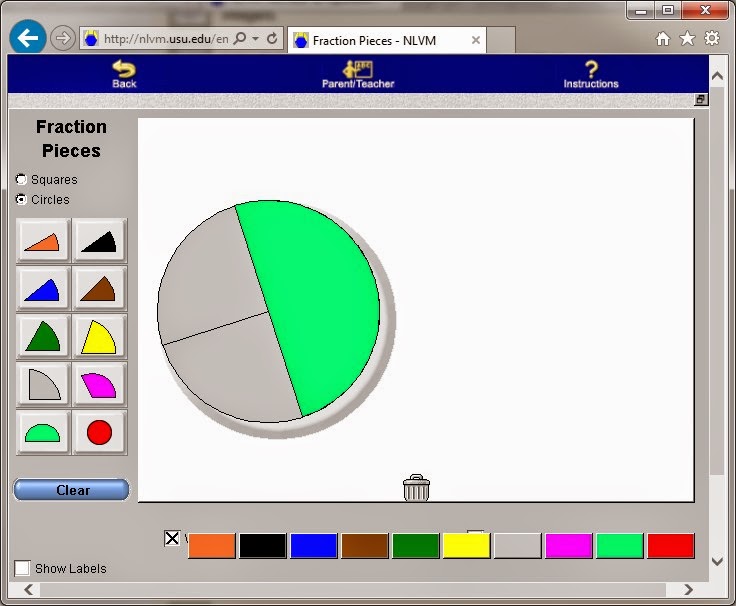 I love how easily customizable these manipulatives are, and that there are applications for so many levels throughout all the strands.

Follow Adam Thompson's board Help for Teachers on Pinterest.
The National Library of Virtual Manipulatives was the best that I found. It is incredibly comprehensive and flexible to your specific needs.
 |
| "The National Library of Virtual Manipulatives (NLVM) is an NSF supported project that began in 1999 to develop a library of uniquely interactive, web-based virtual manipulatives or concept tutorials" |
Checking on one of the boxes will take you to a list of Java applets for that math strand and grade level range. In my third grade class, I use this heavily for place value study.
I love this applet. You simply click on the ones, tens, hundreds, or thousands blocks at the top of the chart to insert pictures below. To the right it shows you the number made by the blocks (I will often conceal this from students depending on the lesson focus/purpose). What I REALLY love about this applet is the visual representation of re-and un-grouping. For example, you can click a hundred square, drag it into the tens column, and it will separate into 10 ten rods. Or, you could use your mouse to highlight 10 ones and they will turn into a tens rod. The students really love watching it happen. I'm always surprised how excitedly they will call out things like"Mr. Thompson! Turn one of the thousands into 10 hundreds again!".

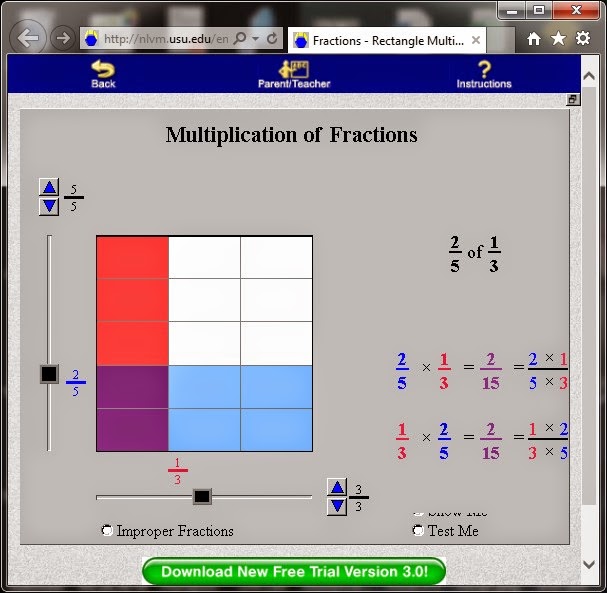
There are several great applets for fractions, also.
I love how easily customizable these manipulatives are, and that there are applications for so many levels throughout all the strands.
For fractions there are apps for fraction identification, equivalency, multiplying, and more
Of course there are several applets focusing on geometry. I love the virtual geoboard!
I would encourage you to check out this great online math resource! I'm not a fan of Java software, the site isn't very "pretty", and most of these could use some updating to modern web standards, but I haven't found anything this comprehensive and customizable. It has been a valuable part of my mathematics instruction.
Subscribe to:
Comments (Atom)